
The hours right after a storm are stressful. There may be water coming through the ceiling, a tree on the fence or a section of roof that is simply gone. What you do in the first two days can make a real difference, both to how much further damage your home takes and to how smoothly your insurance claim goes.
1. Make Sure Everyone Is Safe
Before anything else, check for hazards. Stay away from downed power lines and any standing water near electrical equipment. If you smell gas, leave the house and call your gas company from a safe distance. If there is serious structural damage, such as a sagging roof or cracked load-bearing walls, stay out until it has been checked.
2. Document Everything Before You Clean Up
Photos and video are your most important tools for an insurance claim.
- Photograph damage from several angles, both close up and wide, so the location is clear.
- Record the outside of the house, the roof (from the ground), fences, and any fallen trees.
- Inside, capture water stains, wet flooring, damaged drywall and damaged belongings.
- Keep damaged items if you can, or at least photograph them before throwing them away.
3. Contact Your Insurance Company
Report the damage as soon as you reasonably can. Under current Florida law, homeowners generally have one year from the date of loss to give notice of a new or reopened property insurance claim, and 18 months for a supplemental claim. Don’t wait that long if you can avoid it. The sooner you report, the sooner an adjuster can inspect.
- Write down your claim number and the name of everyone you speak with.
- Ask what documentation your insurer needs and whether it wants to inspect before any repairs.
- Keep every receipt for emergency repairs, tarps, fans and temporary housing.
4. Prevent Further Damage
Most policies expect homeowners to take reasonable steps to protect their property from additional damage. That usually means temporary repairs, not permanent ones.
- Cover roof openings with tarps if it is safe to do so, or have a professional do it.
- Board up broken windows and doors. When it is time for permanent repairs, consider impact-rated windows and doors so you are better protected next time.
- Move belongings away from leaks and start drying wet areas with fans and dehumidifiers. Wet drywall, insulation and carpet can begin growing mold within a day or two in Florida’s humidity.
- Shut off water at the main if a pipe has broken.
Hold off on permanent repairs until your insurer has had a chance to see the damage, unless they tell you otherwise.
5. Be Careful Who You Hire
After every major storm, unlicensed and out-of-area operators show up offering quick repairs, often asking for large deposits up front. Florida’s Department of Business and Professional Regulation (DBPR) urges homeowners to hire only state-licensed contractors. Before you sign anything:
- Verify the contractor’s license at MyFloridaLicense.com or in the DBPR mobile app.
- Ask for proof of insurance.
- Be wary of anyone who wants full payment before starting, pressures you to sign immediately, or says permits aren’t needed.
For more on this, see our guide to choosing a licensed general contractor in Florida.
6. Get a Professional Assessment
Some damage is easy to see. Other damage, like water inside walls or a weakened roof structure, isn’t. A licensed general contractor can assess the full scope, give you a written estimate you can share with your adjuster, and handle the permitted repairs once your claim is approved. ITZ Construction can work directly with your insurance company to make the process easier.
If your home needs more than small fixes, our property rehab and reconstruction team handles everything from water damage to full rebuilds.
Need Help? Talk to ITZ Construction
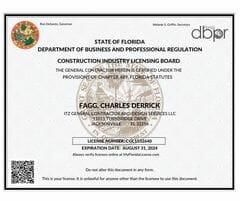
ITZ Construction is a licensed Florida general contractor (CGC1525590) serving Jacksonville, Deltona and the surrounding areas. Request a free estimate online, or call our Jacksonville office at 904-469-8310 or our Deltona office at 407-552-6217.